What archaeology says
The current best estimate for the impact comes from a 2016 study led by Anna Losiak, who radiocarbon-dated charcoal recovered from within the proximal ejecta blanket — material charred by the impact itself and buried instantly, so immune to the reservoir effects that plague lake and bog dating. Her team's result of 3237 ± 10 radiocarbon years places the event shortly after 1530–1450 BC, squarely in the Nordic Bronze Age, when Saaremaa supported farming communities who could not have missed a kilotonne-scale explosion on their small island.
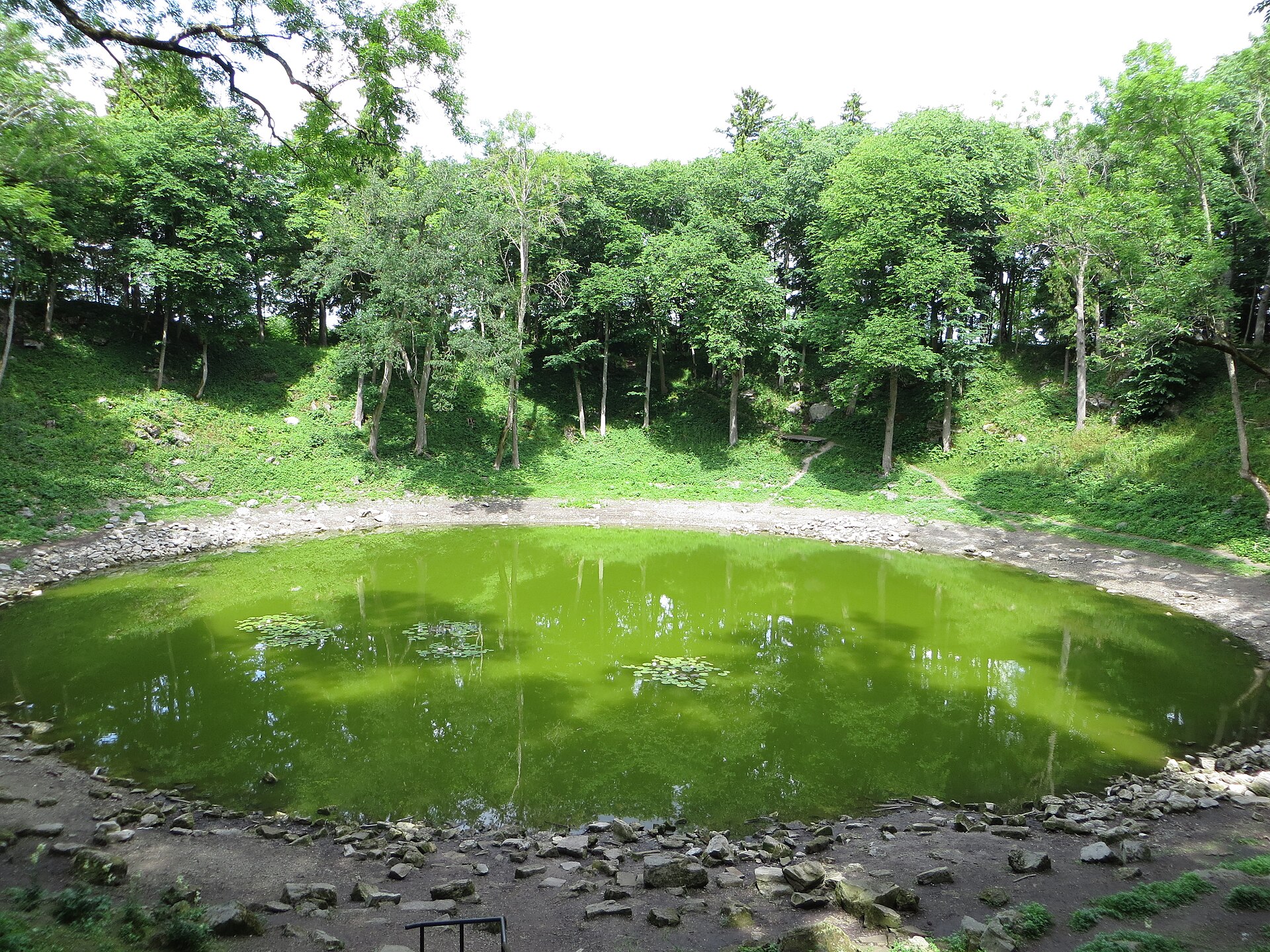
Archaeology supports a long human relationship with the crater. Excavations in the 1970s revealed a fortified settlement beside the lake and a substantial dry-stone wall, 2 to 2.8 metres thick at the base, that appears to have enclosed the crater during the pre-Roman Iron Age (c. 500 BC – AD 50). Inside lay unusually rich deposits of domestic animal bone — horse, ox, sheep, pig and dog — interpreted as offerings, along with a silver hoard. Mainstream researchers read this as a pagan cult site: whether or not living memory of the fall survived, the perfectly round lake in its raised rim was clearly treated as a place apart.
Estonian scholars such as Siim Veski and colleagues have also probed the impact's environmental fingerprint, finding impact-derived iron microspherules in the nearby Piila bog. Their reading of the peat originally suggested a much later event, around 800–400 BC, accompanied by signs of local ecological disturbance — a result now generally superseded by the ejecta charcoal dates, but a reminder of how hard small craters are to date.
- Charcoal within the impact ejecta blanket radiocarbon-dated to shortly after 1530–1450 BC (Losiak et al. 2016)
- Nine-crater field with recovered iron meteorite fragments confirming a single fragmenting impactor
- Iron Age fortified settlement and a 2.3–2.8 metre thick stone wall enclosing the crater lake
- Abundant sacrificed domestic animal bones and a silver hoard indicating long cult use
- Impact microspherules traced in Saaremaa bogs, tying regional sediment layers to the event