Ancient Engineering · Cusco Region, Peru

Machu Picchu

The cloud-wrapped royal estate the conquistadors never found — and a showcase for the 'two styles of masonry' argument.

Mainstream: c. AD 1420–1530 (royal estate of Pachacuti)Alternative: Date not seriously disputed — sceptics instead argue the finest polygonal masonry belongs to an older megalithic layer the Inca built over-13.16°, -72.55°

At a glance

Machu Picchu
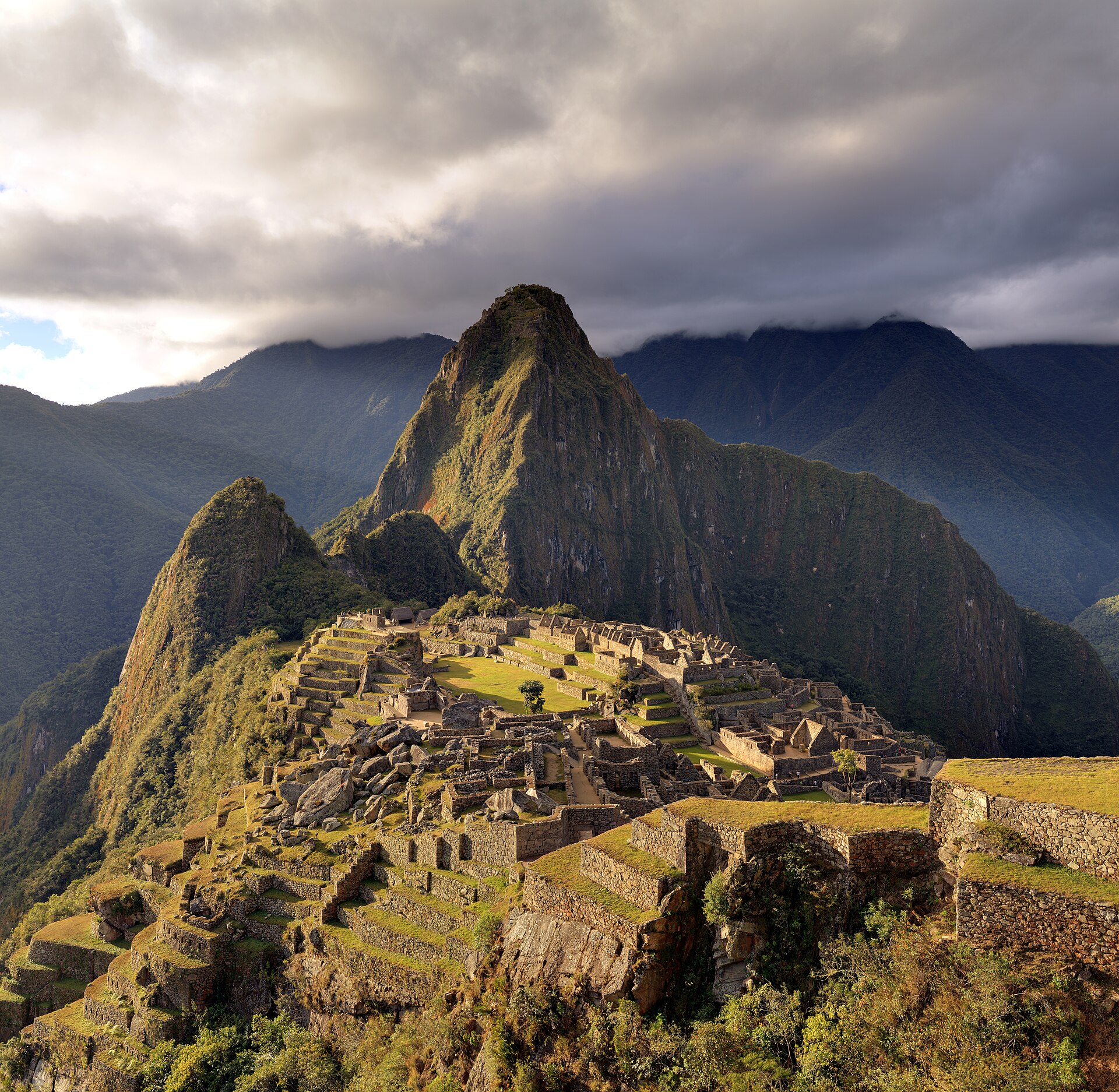
Photo: Martin St-Amant (S23678) · CC BY-SA 3.0

Perched on a knife-edge ridge 2,430 metres up between the peaks of Machu Picchu and Huayna Picchu, above a hairpin bend of the Urubamba River, Machu Picchu is the best-preserved major Inca site in existence. Its roughly 200 structures — temples, residences, fountains and warehouses linked by stairways and fed by a spring-fed canal — sit atop an extraordinary hidden engineering achievement: deep terraced foundations and drainage layers that have kept the city stable on its rainy ridge for six centuries. Brought to world attention by Hiram Bingham in 1911, it was never found by the Spanish, which is precisely why so much of it survives.

See it on the globe →
The mainstream view

What archaeology says

Archaeologists interpret Machu Picchu as a royal estate built for the emperor Pachacuti, the ruler who transformed the Inca state into an empire — a seasonal palace, religious retreat and administrative centre serving perhaps 750 people at its peak. The identification rests on a 16th-century Spanish legal document connecting the estate to Pachacuti's lineage, on the site's architecture of elite residences and shrines rather than ordinary dwellings, and on excavated burials of the diverse retainer population who served there, whose bones and grave goods indicate people drawn from all over the empire.

In 2021 a Yale-led team under Richard Burger published the first large AMS radiocarbon programme on human remains from the site's cemeteries, showing occupation from about AD 1420 to the 1530s — beginning roughly two decades earlier than the traditional text-based chronology, which had tied construction to Pachacuti's supposed accession in 1438. The result quietly made an important methodological point: Inca history reconstructed from colonial chronicles is less reliable than direct dating. Meanwhile, historians Donato Amado Gonzales and Brian Bauer showed in 2022 that the Incas almost certainly called the town Huayna Picchu — the name Machu Picchu properly belongs to the neighbouring mountain.

Construction questions are comparatively well answered here: the granite was quarried on the ridge itself (a jumbled quarry zone still sits within the site), and hydrologist Kenneth Wright's studies documented the spring collection works, the 16-fountain cascade and the massive subsurface drainage that make the city an engineering masterpiece. Geologist Rualdo Menegat has even argued the Incas deliberately built on a web of fault intersections, exploiting pre-fractured stone and superior drainage.

Key evidence cited
  • 2021 AMS radiocarbon dates (Burger et al.) placing occupation at c. AD 1420–1530
  • A 16th-century legal document tying the estate to Pachacuti's royal lineage
  • An on-site granite quarry with blocks abandoned at every stage of working
  • Excavated retainer burials with imperial-era grave goods from across the Inca world
  • Wright's engineering studies of Inca-designed water supply, fountains and terrace drainage
The alternative view

What the skeptics propose

Almost nobody disputes that the Inca lived at Machu Picchu; the alternative argument is about layers. Writers such as Brien Foerster — often drawing on Jesus Gamarra's framework — point to the dramatic contrast between the site's masonry styles: the flowing, mortar-free polygonal perfection of the Temple of the Sun's curved wall and the adjacent 'Royal Tomb' grotto, versus the rougher, mortar-set fieldstone of most of the town. In their reading, the finest work — often the lowest courses, seemingly fused to living bedrock — is the remnant of a much older megalithic culture, and the Inca were squatters and renovators who added the cruder 90 per cent on top.

Proponents highlight the Temple of the Three Windows and the so-called Temple of the Moon on Huayna Picchu, where superb sculpted bedrock sits beneath or behind lesser stonework, and note visible displacement in the Main Temple's megalithic wall as possible evidence of an ancient cataclysm rather than simple settling. Graham Hancock has folded Machu Picchu into his broader case that a lost civilisation's survivors seeded megalithic techniques across the Andes.

Mainstream archaeologists reply that the two styles reflect function and status, not separate epochs: fine ashlar and polygonal work was reserved for temples and royal quarters across the empire, while ordinary buildings got fieldstone — the same gradient visible in Cusco itself. The on-site quarry contains blocks abandoned at every stage of production, the Main Temple's lean is well explained by foundation subsidence on fill, and the 2021 radiocarbon programme found no trace of occupation before the 1400s. The steelman that remains: no excavation has ever specifically targeted and dated the foundations of the finest structures, so the 'older layer' claim, however unlikely, has not been directly tested.

Key evidence cited
  • Stark contrast between flawless polygonal temple masonry and rough mortar-set housing
  • Finest courses often at the base, appearing moulded onto sculpted living bedrock
  • Displaced megaliths in the Main Temple wall read by some as cataclysm damage
  • Sculpted caves (Royal Tomb, Temple of the Moon) framed by later, cruder infill walls
  • No excavation has directly dated the foundations of the premier megalithic structures

Genuinely open questions

  1. Why was Machu Picchu abandoned — plague, the Spanish civil-war era collapse of royal estates, or something else?
  2. What was the full ritual role of the sculpted caves and the Intihuatana stone?
  3. How much earlier than the traditional 1438 date did imperial Inca expansion actually begin?

Worth knowing

We may have been calling it the wrong name for a century: 2022 archival research found the Incas knew the town as Huayna Picchu. 'Machu Picchu' — 'old mountain' — is the peak that looms behind the classic postcard view.