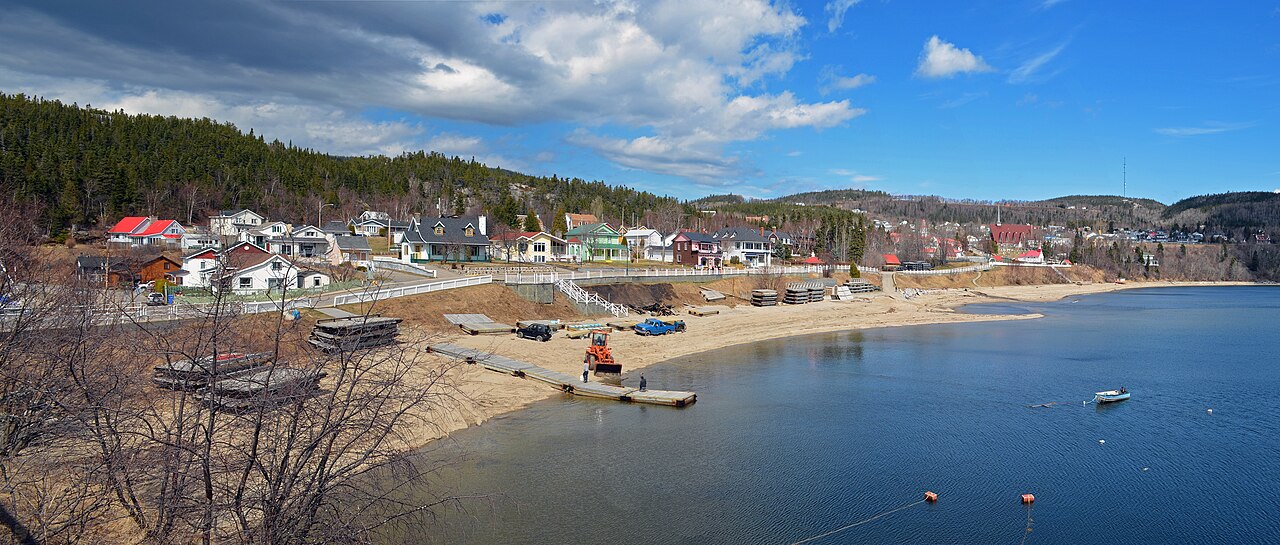
Lost Worlds · Tadoussac, Quebec, Canada (mouth of the Saguenay River, gateway to the fabled kingdom)

Kingdom of Saguenay

An Iroquoian chief told the French of a northern kingdom of gold and blond men — and the diamonds France brought home were quartz.

Mainstream: 1535-1543 (Donnacona's tale and the Cartier-Roberval searches)Alternative: Before 1535 (a real rich realm — or a memory of Norse contact — up the Saguenay)48.14°, -69.72°

At a glance

Kingdom of Saguenay
Photo: Selbymay · CC BY-SA 3.0

When Jacques Cartier wintered on the St Lawrence in 1535-36, the St Lawrence Iroquoian chief Donnacona told him of the Kingdom of the Saguenay: a realm up the dark fjord-river north of Stadacona, rich in gold, silver, copper and spices, whose people — in some tellings — were white men with beards, or blond, and possessed of woollen cloth. Cartier seized Donnacona and took him to France, where the chief repeated the tale to King Francis I, adding marvels of unipeds and men who flew. The story helped secure royal backing for the great colonising expedition of 1541-43 under Cartier and Roberval, which searched for Saguenay, failed, and collapsed — leaving behind one of Canada's founding jokes: the barrels of Canadian diamonds and gold Cartier carried home proved to be quartz and iron pyrite.

See it on the globe →
The mainstream view

What archaeology says

Historians offer three compatible readings of the Saguenay tale, none involving a golden kingdom. First, the geographic kernel: the Saguenay corridor was a real trade route, and native copper genuinely moved through northern exchange networks from sources around Lake Superior; a distant land where metal came from was true in substance, inflated in the telling. Second, translation and expectation: Cartier interrogated through a thin linguistic filter, primed by Mexico and Peru to hear kingdom and gold; Iroquoian accounts of the interior — perhaps including references to copper, to the fur-rich north, or to rival peoples — were shaped by his questionnaire. Third, motive: Donnacona, an astute politician, learned what the French wanted and, especially once captive in France, had every incentive to embellish a kingdom he alone could guide them to, since it promised his return home. He never returned; he died in France around 1539.

The consequences were entirely real. Francis I cited the wonders of Saguenay in mounting the 1541-43 enterprise — France's first true colonisation attempt in the Americas, at Charlesbourg-Royal near Quebec. Cartier abandoned the colony in 1542 carrying his supposed treasure; assayed in France, the gold was iron pyrite and the diamonds quartz crystals from the promontory Cartier had named Cap aux Diamants — today's Cap Diamant beneath the Citadel of Quebec City — giving the French language the proverb faux comme les diamants du Canada, false as Canadian diamonds. Roberval's remnant colony failed by 1543, and France largely withdrew from the St Lawrence for sixty years.

Scholars such as Marcel Trudel treated Saguenay as the classic case of a chimera directing empire; more recent ethnohistorians emphasise Donnacona's agency, reading the kingdom as an Iroquoian diplomatic construction — a story calibrated to French appetites, and one of the earliest documented examples of indigenous people strategically managing European information.

Key evidence cited
  • The tale's entire documentary basis is Cartier's narratives and French court records of Donnacona's statements — no independent source describes such a kingdom.
  • Donnacona had a documented motive: taken to France in 1536, he could only return home as the indispensable guide to Saguenay; he embellished accordingly and died in France without returning.
  • The 1541-43 Cartier-Roberval expedition physically searched and found no kingdom; the venture collapsed within two years.
  • Cartier's treasure was assayed in France as quartz and iron pyrite, the origin of the proverb false as Canadian diamonds — the wealth evaporated on first scientific test.
  • The credible elements (copper from distant sources, fur wealth) match known indigenous trade networks and need no lost kingdom.
  • Donnacona's later marvels — unipeds, flying men, pygmies — are stock medieval wonders, marking the account as performance rather than geography.
The alternative view

What the skeptics propose

The romantic reading takes Donnacona at closer to face value. The most discussed version is the Norse hypothesis: the blond, bearded, woollen-clad men of the kingdom, some writers have argued, preserve a garbled memory of Norse Greenlanders — whose voyages to Markland (Labrador) for timber are attested as late as 1347 in Icelandic annals — or even of a surviving Norse remnant trading down into the interior. Popular historians of the Vikings-in-America school, from the 19th century onwards, folded Saguenay into their case alongside the Maine Penny and Newfoundland's L'Anse aux Meadows; the writer Farley Mowat, in books such as Westviking and The Farfarers, built imaginative reconstructions of northern European voyagers (in his later work, pre-Norse Albans) settling exactly these subarctic corridors.

A second literalist strand holds that Saguenay described a real indigenous polity or resource region: a copper-rich trading sphere towards Lake Superior or the interior north, whose wealth in metal was fact, not fabrication — pointing out that Old Copper Complex metalworking in the Great Lakes is genuine and ancient, and that European cloth and goods from early Atlantic contacts (Basque whalers were in the Strait of Belle Isle by the early 1500s) could already have been circulating inland, explaining the woollen cloth detail without any deception by Donnacona.

A third, more local tradition simply refuses the hoax framing of Cap Diamant: Quebec's rocks did glitter, the St Lawrence valley did later yield real mineral wealth, and Cartier's error was metallurgical, not moral. On this view the Kingdom of Saguenay was the first draft of a true intuition — that enormous riches (in furs, timber, and eventually minerals like the aluminium and hydropower economy of the modern Saguenay) really did lie up that river; the legend simply priced the wrong commodities.

Key evidence cited
  • Norse voyages to Markland (Labrador) are documented in Icelandic annals as late as 1347 — northern European visitors within traditional memory of Donnacona's era are historical fact.
  • The kingdom's copper was real: Great Lakes native copper circulated through exactly the trade networks the Saguenay corridor served.
  • Basque and Breton crews frequented the Strait of Belle Isle and lower St Lawrence by the early 1500s, so European goods (including woollens) could genuinely have been reported inland before Cartier.
  • Multiple Stadaconans, not only Donnacona, repeated the Saguenay account to Cartier, and the ten captives taken to France reportedly maintained it — consistent testimony, literalists note.
  • The specific details — white, bearded, clothed men — are oddly gratuitous inventions for an Iroquoian speaker, but a natural description of Europeans, supporting a memory-of-contact reading.
  • The Saguenay-Lac-Saint-Jean interior genuinely proved rich (furs then, minerals and hydropower later), so the claim of great wealth up the river was not intrinsically absurd.

Genuinely open questions

  1. Was Donnacona reporting, translating, negotiating, or inventing — and can ethnohistory disentangle which?
  2. Do the blond men reflect Norse or early Basque/Breton contact, pure misunderstanding, or French embellishment of what was actually said?
  3. What did the word rendered Saguenay mean to the St Lawrence Iroquoians, whose entire people vanished from the valley before Champlain's arrival in 1603?
  4. Did any European goods or people reach the St Lawrence interior before 1534 by northern routes?

Worth knowing

Cap Diamant — Cape Diamond — still carries the name Cartier gave the promontory where he gathered his worthless diamonds, and Quebec City's Citadel now stands on top of it; for centuries after, false as a Canadian diamond remained a French byword for a glittering fraud.