What archaeology says
Historians treat cartographic Norumbega as a classic phantom: a real Algonquian place-name (possibly meaning quiet stretch of water) inflated by rumour, wishful geography and the era's hunger for another Mexico. Verrazzano's coastal reconnaissance of 1524 supplied the seed; the French pilot Jean Alfonse described a rich river and city in the 1540s; Ingram's tavern-worthy testimony, taken down for Sir Humphrey Gilbert's promoters in 1582, supplied crystal towers and rubies. Mapmakers such as Mercator and Ortelius dutifully engraved the city. Champlain's methodical survey of the Penobscot ended the affair: he reported no such city, and Norumbega faded to a regional label before vanishing.
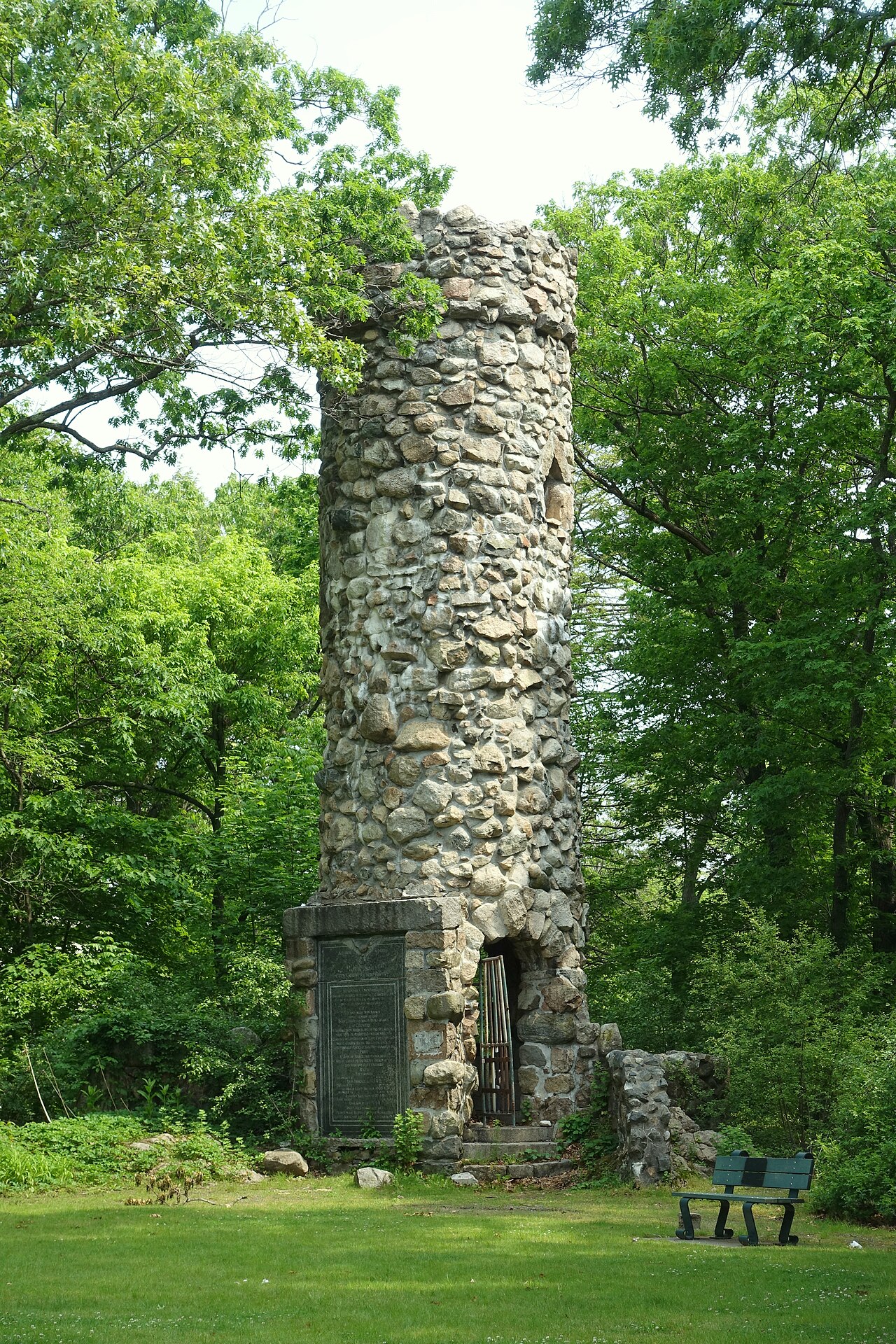
The Viking revival is a separate, well-documented episode in American intellectual history. Eben Norton Horsford — the Rumford Professor at Harvard who made a fortune reformulating baking powder — became convinced that Norumbega derived from Norvega (Norway) and that Leif Erikson's Vinland lay on Massachusetts Bay. In a series of lavish self-published volumes (including The Discovery of the Ancient City of Norumbega, 1890) he located Leif's house on the Charles in Cambridge, identified stone walls and old dams in Watertown and Weston as Norse wharves and fish weirs, and in 1889 erected the 38-foot Norumbega Tower at the confluence of Stony Brook and the Charles in Weston to mark the Norse city and fort. He also funded Anne Whitney's statue of Leif Erikson, which still stands on Commonwealth Avenue in Boston.
Professional archaeologists found nothing Norse in any of it: Horsford's evidence consisted of colonial-era walls, dams and etymological free association. His campaign is now studied as part of the 19th-century Viking vogue, in which New England Protestants embraced a Norse discovery of America partly to trump Columbus. The only authenticated Norse site in North America remains L'Anse aux Meadows, Newfoundland, found in 1960 — and the only broadly accepted pre-Columbian Norse artefact from US soil is the Maine Penny, an Olaf Kyrre-era Norwegian coin reported from the Goddard site at Naskeag Point, Brooklin, Maine, in 1957, which mainstream opinion explains as an item traded down from Norse contact further north (if it is not a planted hoax).
- Norumbega's cartographic life is fully documented, from Oranbega on the 1529 Verrazzano map through Mercator and Ortelius to its disappearance after 1600.
- Champlain's 1604-05 exploration of the Penobscot found Wabanaki villages and no city, and he said so explicitly — the phantom died on contact with survey.
- David Ingram's 1582 testimony, the main eyewitness source, is a hearsay narrative of a 3,000-mile walk, containing stock marvels (elephants, rubies) that discredit it.
- Excavations have never produced Norse material anywhere in New England; Horsford's Norse wharves and walls are colonial and 19th-century features.
- The only authenticated Norse site in the Americas is L'Anse aux Meadows, Newfoundland — far from the Charles River.
- The Maine Penny's find context is unverifiable (a single finder's report from 1957), and identical Olaf Kyrre pennies circulated on the collector market at the time.