Belief & Society · Acre, western Brazilian Amazonia

The Amazon Geoglyphs of Acre

Hundreds of giant geometric ditches hidden for centuries under rainforest — and the case where the fringe hunch of a peopled Amazon turned out to be right.

Mainstream: c. 200 BC – AD 1300 (with some enclosures possibly older)Alternative: Date not seriously disputed — the argument here is about what the sites mean for the 'pristine Amazon' idea, not their age-9.88°, -67.53°

At a glance

The Amazon Geoglyphs of Acre
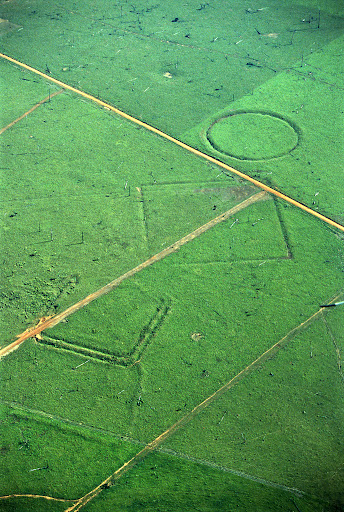
Photo: Sanna Saunaluoma · CC BY-SA 3.0

Across roughly 13,000 square kilometres of Acre state in the far west of Brazilian Amazonia lie more than 450 pre-Columbian earthworks known as geoglyphs: perfectly geometric enclosures — circles, squares, hexagons and combinations of them — outlined by ditches up to several metres deep and banks of piled-up earth, most between 100 and 300 metres across. They are not drawings on the surface in the Nazca sense but sculpted ground: monumental ditched enclosures, often linked by embanked avenues or 'roads' running off into the forest. For centuries they lay invisible beneath mature terra firme rainforest, and only began emerging in numbers from the 1970s onward as cattle ranching cleared the canopy, with LiDAR and satellite survey later revealing hundreds more still under trees. The Acre geoglyphs matter far beyond their own region because they overturned a deep orthodoxy. Twentieth-century scholarship long held that Amazonia was a 'counterfeit paradise' — a green desert of poor soils incapable of supporting large, complex societies, its forests essentially pristine wilderness untouched by dense human populations. The scale, number and organisation of the Acre earthworks helped demolish that view. Here was monumental construction, requiring coordinated labour and long-term planning, deep in the western Amazon, built by people who had been shaping the forest around them for thousands of years.

See it on the globe →
The mainstream view

What archaeology says

Systematic study of the geoglyphs was led above all by the Brazilian archaeologist Denise Schaan (who died in 2018) together with the Finnish archaeologist Martti Pärssinen and colleagues such as Sanna Saunaluoma, who mapped, excavated and dated dozens of sites. Radiocarbon dates from ditch fills and associated deposits cluster mainly between about 2,000 and 700 years ago, with pottery, grinding stones and other finds pointing to repeated use. A minority of samples run considerably older, and a 2020 study in Antiquity argued for land-use at these locations stretching back millennia. The prevailing interpretation is that the enclosures were not fortresses or villages but ceremonial and gathering places — the ditches too shallow and the interiors too clean of domestic refuse for defence or dense habitation — used intermittently by dispersed populations for ritual and communal events.

The most consequential mainstream work came from environmental archaeology. Jennifer Watling, with Schaan, Pärssinen and others, published a landmark 2017 study in the Proceedings of the National Academy of Sciences reconstructing 6,000 years of vegetation at two geoglyph sites, Jaco Sa and Fazenda Colorada, using phytoliths, charcoal and stable carbon isotopes. The result was striking: the region had been dominated by bamboo forest for millennia, and the builders had not clear-felled it. Instead they made only small, temporary openings to construct the earthworks, while enriching the surrounding forest with useful species such as palms — a form of long-term agroforestry rather than wholesale deforestation.

This reframed the whole debate about pre-Columbian Amazonia. Together with terra preta (Amazonian dark earths), raised fields and the later LiDAR discoveries of urban-scale settlements elsewhere in the basin, the geoglyphs became key evidence that large parts of the 'wild' Amazon are in fact an anthropogenic landscape, shaped and managed by sizeable societies for thousands of years before European contact.

Key evidence cited
  • Over 450 mapped geometric ditched enclosures across ~13,000 km2 of Acre, documented by Schaan, Pärssinen and colleagues
  • Radiocarbon dates on ditch deposits clustering c. 2,000–700 BP, with pottery and grinding stones showing repeated use
  • Watling et al. (2017, PNAS) phytolith, charcoal and isotope record showing 6,000 years of managed bamboo forest, not clear-felling
  • Clean, refuse-poor interiors and shallow ditches indicating ceremonial gathering places rather than forts or dense villages
  • Convergence with terra preta, raised fields and LiDAR-detected settlements elsewhere confirming a widely peopled ancient Amazon
The alternative view

What the skeptics propose

The Acre geoglyphs are unusual in this collection because the 'alternative' story is one where the fringe intuition proved right and the establishment wrong — not the reverse. For much of the twentieth century, the mainstream position, crystallised by the influential archaeologist Betty Meggers in her book Amazonia: Man and Culture in a Counterfeit Paradise, held that tropical-forest soils were too poor to sustain complex societies, so Amazonian peoples were necessarily small, mobile and simple. Against that consensus, a scattered set of dissenters — geographers, ethnohistorians and independent researchers — kept insisting that early Spanish chronicles describing dense riverside populations and vast managed landscapes should be taken seriously, and that the Amazon was far more peopled and engineered than the textbooks allowed.

The geoglyphs vindicated that heterodox reading. They are monumental, coordinated and old, and they sit within a forest that the builders had been actively cultivating for millennia. Anthropologists such as William Balee and the late Denise Schaan had already argued that much of Amazonia is a 'cultural forest' — a garden shaped by human hands — and the earthworks put hard, datable evidence behind that claim. In this case the popular imagination and the contrarians were closer to the truth than the reigning experts, a reminder that orthodoxy can be wrong and that the burden of proof cuts both ways.

Beyond that legitimate reappraisal, the geoglyphs have also attracted the usual ancient-mysteries treatment: online claims that the sheer geometric precision, the alignments, or the labour involved point to a lost advanced civilisation, or that the enclosures echo the geometry of sites on other continents. Archaeologists reject these embellishments. The precision is well within the reach of people using cords, stakes and communal labour; the forms evolve locally over centuries; and the material culture is unmistakably indigenous Amazonian. The genuinely revolutionary story — that ordinary Amazonian societies built monuments and gardened the forest at scale — needs no lost civilisation to be extraordinary.

Key evidence cited
  • The sites decisively overturned Betty Meggers's 'counterfeit paradise' orthodoxy of a thin, simple Amazonian population
  • Early Spanish chronicles of dense riverside populations, long dismissed, look far more credible in their light
  • Evidence of millennia of deliberate forest enrichment supports the 'cultural forest' thesis of Balee and Schaan
  • Monumental, coordinated construction deep in terra firme forest shows organised societies where none were expected
  • The whole episode demonstrates that entrenched expert consensus can be wrong and heterodox readings vindicated

Genuinely open questions

  1. What exactly were the enclosures for — which combinations of ceremony, feasting, calendrical or social display best fit the clean interiors and linking avenues?
  2. How large and how socially organised were the builder populations, given how little permanent settlement debris the sites contain?
  3. How many more geoglyphs remain hidden under standing forest, and what will full-basin LiDAR survey reveal about their true extent?

Worth knowing

The very deforestation that alarms conservationists is what exposed the geoglyphs in the first place — bulldozing pasture for cattle peeled back the canopy to reveal that the 'untouched' rainforest had been landscaped by people thousands of years ago.