Belief & Society · Xagħra, Gozo, Malta

Ġgantija Temples

Temples of the giantess — older than the pyramids, built of megaliths up to 50 tonnes on a small Mediterranean island.

Mainstream: c. 3600–2500 BC (southern temple c. 3600 BC)Alternative: Significantly older origins proposed — Hancock and the Mifsuds argue for Palaeolithic settlement of Malta and temple origins reaching back towards the end of the Ice Age36.05°, 14.27°

At a glance

Ġgantija Temples
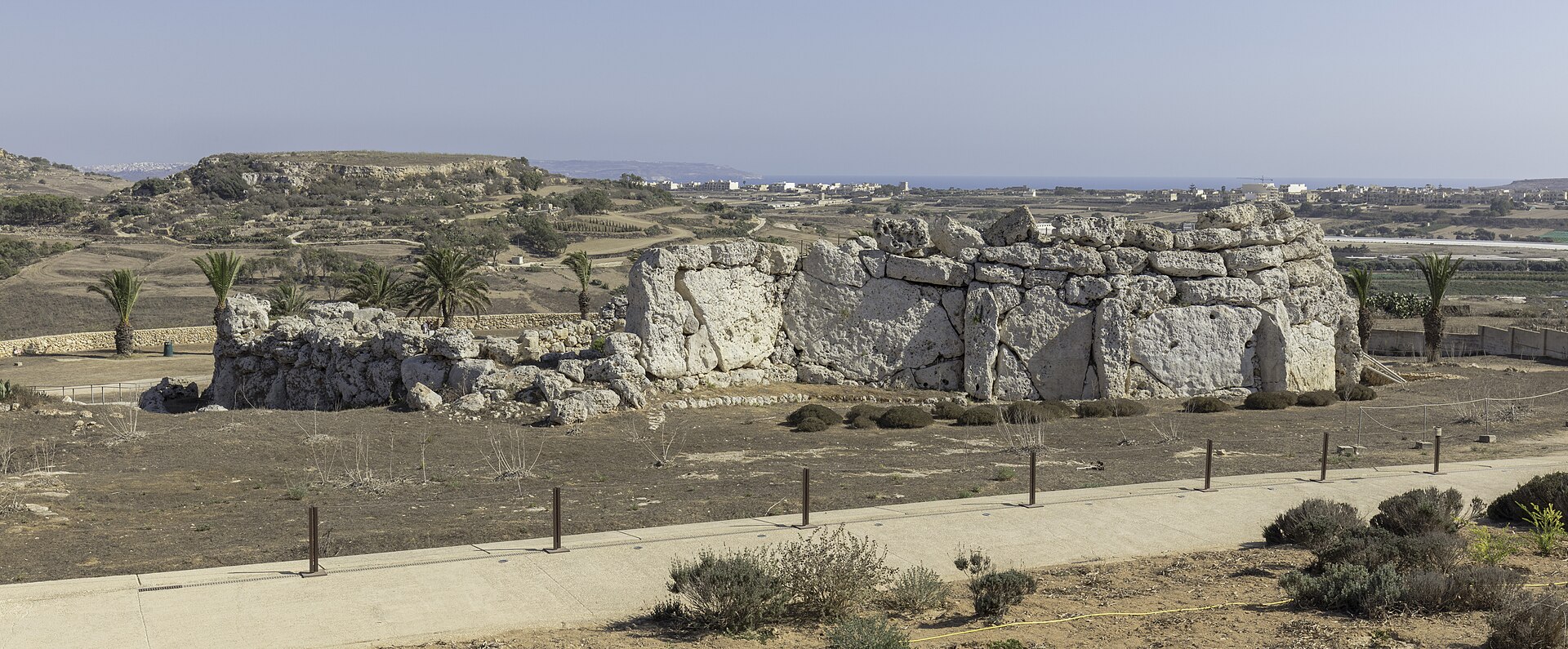
Photo: Diego Delso · CC BY-SA 4.0

On a plateau at Xagħra on the island of Gozo stand two conjoined temples within a single boundary wall — Ġgantija, 'the giantess's place'. The southern temple, raised around 3600 BC, is among the oldest free-standing monumental buildings on Earth, its rough coralline limestone megaliths reaching over five metres and an estimated 50 tonnes, enclosing clover-leaf chambers once plastered and painted red. Ġgantija opens the extraordinary Maltese temple period, which produced Ħaġar Qim, Mnajdra, Tarxien and others across Malta and Gozo before the culture vanished around 2500 BC. The name preserves the folk belief that only giants could have built it.

See it on the globe →
The mainstream view

What archaeology says

Ġgantija was cleared as early as 1827 under Col. John Otto Bayer — sadly with little recording — and studied through the 20th century by the Museums Department and archaeologists such as Themistocles Zammit, David Trump and, most recently, the Cambridge-led FRAGSUS project under Caroline Malone. The dating now rests on multiple independent methods: radiocarbon dates on plant and animal remains from the temple deposits (c. 3600–3050 BC) and optically stimulated luminescence dates from the stratigraphy (c. 3600–3080 BC for the lower levels), which agree closely. That makes the southern temple older than Stonehenge's sarsens and Egypt's pyramids, and the temple culture as a whole a purely local achievement of Neolithic farmers whose ancestors reached Malta from Sicily around 5900 BC.

The construction problem is real but tractable: the builders used the harder coralline limestone for walls and softer globigerina for interiors, and left clues to their methods — including stone spheres found at temple sites interpreted by many as ball-bearing-like rollers for moving megaliths, and nearby cart-rut-scored terrain. Temple interiors held libation holes, animal-bone deposits and altars suggesting sacrifice and feasting; associated art includes the corpulent 'fat lady' figurines often linked to a fertility cult, though their sex and meaning are debated. The FRAGSUS project also charted the environmental strain — deforestation, soil erosion, drought — that likely contributed to the temple culture's collapse around 2500 BC, after which Bronze Age newcomers reused the ruins.

For mainstream archaeology, Ġgantija's significance is precisely that an isolated island community of a few thousand farmers, without metal, writing or the wheel, independently invented monumental architecture centuries before the more famous civilisations of Egypt and Mesopotamia.

Key evidence cited
  • Agreeing radiocarbon (c. 3600–3050 BC) and OSL (c. 3600–3080 BC) dates from Ġgantija's deposits and stratigraphy
  • A continuous, excavated cultural sequence from Sicilian-derived farmers (c. 5900 BC) through the temple period
  • Stone spheres and local quarry sources indicating practical megalith-moving methods
  • FRAGSUS project evidence of environmental stress explaining the temple culture's collapse c. 2500 BC
  • Absence of any verified Palaeolithic artefacts or securely dated pre-Neolithic human remains on Malta
The alternative view

What the skeptics propose

Gozitan folklore explains the megaliths with the giantess Sansuna, who ate only broad beans and honey and carried the stones from Ta' Ċenċ on her head — with her baby slung on one shoulder — in a single day. Alternative historians take the folklore as smoke pointing to a real fire: a lost chapter of Maltese prehistory. Graham Hancock devoted over a hundred pages of Underworld (2002) to Malta and returned in his Netflix series Ancient Apocalypse ('Sirius Rising', 2022), arguing that Malta was settled far earlier than archaeology allows, that temple-building know-how descends from the Ice Age, and that structures may lie drowned on the shelf between Malta and Sicily, flooded when sea levels rose — citing the contested underwater site of 'Ġebel ġol-Baħar'. He drew heavily on Maltese physician Anton Mifsud and colleagues, whose books argue for Palaeolithic humans on Malta 15,000+ years ago and identify Malta with Plato's Atlantis, destroyed by a catastrophic flood around 2200 BC.

A related astronomical strand, advanced by researchers such as Klaus Albrecht and amplified by Hancock's collaborators, holds that the temples' south-easterly orientations track the winter solstice sunrise or the rising of Sirius at remote epochs, and that back-calculating the precession of bright stars yields construction dates thousands of years earlier than 3600 BC. Sceptics reply that orientation-based dating is circular — you must first assume which star mattered — and that the temples' alignments are adequately explained within their radiocarbon-dated era, with Mnajdra's solstice light effects showing the builders' real but Neolithic-period astronomy.

The mainstream rebuttal to the deep-age case is blunt: Ġgantija's chronology is now fixed by two independent laboratory methods that agree, no securely Palaeolithic artefact or human bone has ever been verified on Malta (claims from Għar Dalam cave rest on contested taurodont teeth), and the alleged underwater temple has never been documented to professional standards. Yet even critics concede the deeper puzzle the alternative camp keeps alive: why did so small an island produce architecture so precocious, and why did its temple civilisation end so completely?

Key evidence cited
  • The Sansuna giantess tradition, read as folk memory of extraordinary builders
  • Mifsud's taurodont teeth from Għar Dalam, claimed as evidence of Palaeolithic (Neanderthal-era) Maltese
  • Hancock's argument that skills evident at Ġgantija imply a longer, partly submerged development
  • Reports of the underwater 'Ġebel ġol-Baħar' structure off St Julian's, claimed as a drowned temple
  • Astronomical back-calculations (solstice and Sirius orientations) proposed to yield far older construction epochs

Genuinely open questions

  1. How did a few thousand islanders organise the quarrying and raising of 50-tonne megaliths?
  2. What drove the abrupt and total end of the Maltese temple culture around 2500 BC?
  3. What do the 'fat lady' figurines and clover-leaf temple plans actually represent?

Worth knowing

In Gozitan legend the giantess Sansuna built Ġgantija on a diet of nothing but broad beans and honey, hauling five-metre megaliths with a baby on her shoulder — the temples' name simply means 'belonging to the giantess'.