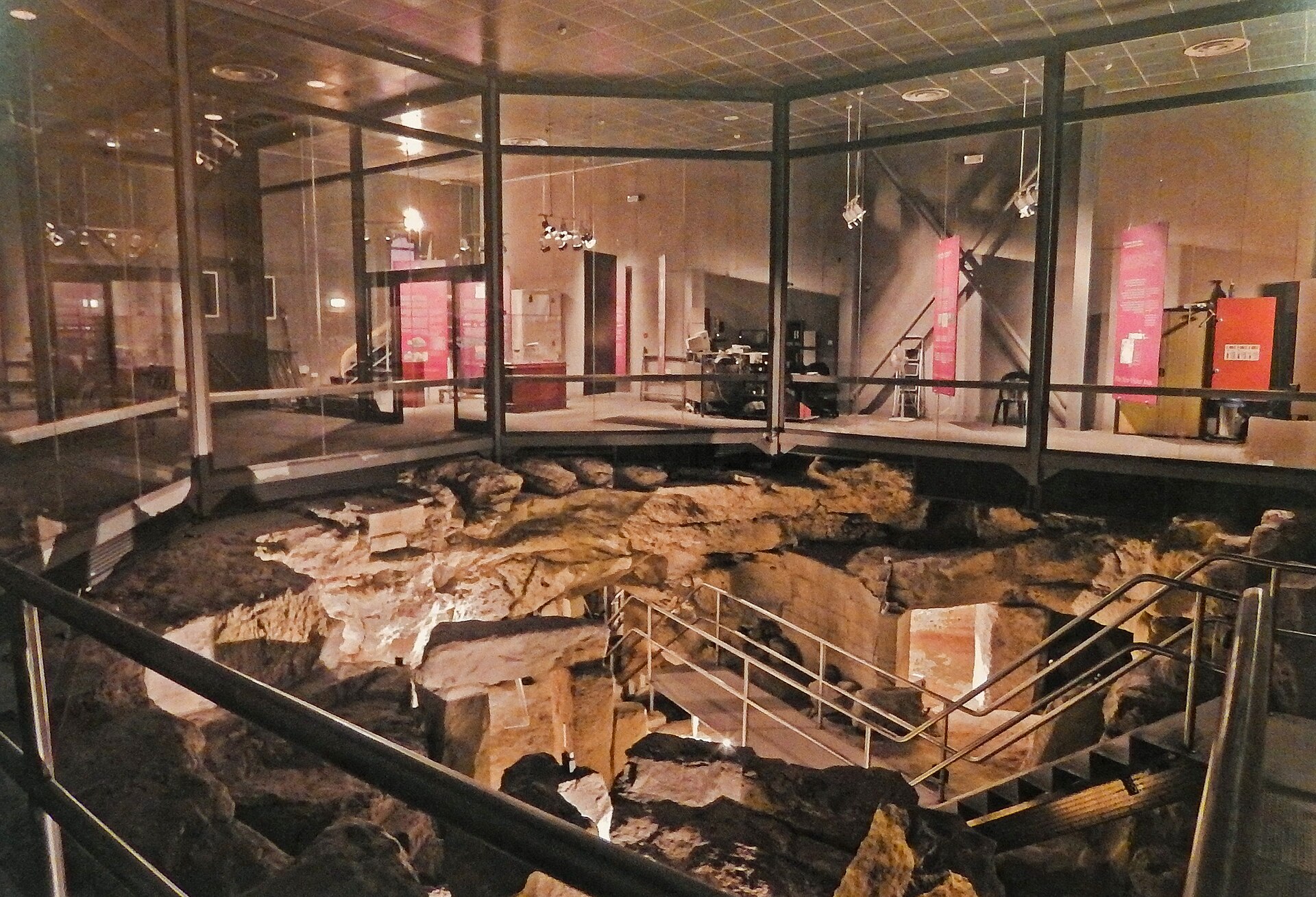
What archaeology says
After the 1902 discovery was initially concealed by the builders, the site was investigated first by Fr Manuel Magri and then, from 1907, systematically excavated by Sir Themistocles Zammit, who published his findings and estimated the remains of some 7,000 individuals (the figure of 33,000 sometimes quoted is a later inflation). Pottery seriation and comparison with Malta's dated temples place the Hypogeum's use from the Żebbuġ phase around 4000 BC to the Tarxien phase ending about 2500 BC — the lowest level probably the earliest. It functioned as a collective burial place and sanctuary: bodies were interred with red ochre, beads, amulets and figurines, and the upper levels seem to have hosted ritual, with a rock-cut 'Holy of Holies' and the 'Snake Pit' possibly used for offerings. The Sleeping Lady, a modelled clay figure of a woman asleep on a couch, is the masterpiece of the assemblage and now rests in Malta's National Museum of Archaeology.
The site's acoustics have attracted serious study. The 'Oracle Room' contains a carved niche whose low-voice resonance booms through the complex; measurements associate strong resonance behaviour around 110 Hz, comparable to values reported in other ancient chambers. A 2008 study by UCLA neuroscientist Ian Cook found that listening at 110 Hz shifted volunteers' EEG activity — relative deactivation in language-linked left temporal regions and a shift towards right-frontal patterns associated with emotional processing — and archaeoacoustics conferences held in Malta in 2014 (organised by Linda Eneix's OTS Foundation, with researchers such as Paolo Debertolis) explored whether temple builders exploited such effects. Mainstream caution remains: resonance is an inherent property of hard-walled rock chambers, and there is no way to prove the builders tuned it deliberately, though the Oracle niche's placement is suggestive.
Conservation, not mystery, dominates current work: Heritage Malta rebuilt the visitor system around microclimate control after studies showed breath and light were destroying the ochre paintings, and the site reopened in 2017 after a major environmental upgrade.
- Zammit's systematic excavation reports (from 1907) documenting stratified burials of roughly 7,000 individuals
- Pottery sequences tying the Hypogeum's use to Malta's dated Żebbuġ–Tarxien phases (c. 4000–2500 BC)
- Architectural mimicry of above-ground temples, carved with stone, flint and antler tools left in the record
- Anthropological re-examinations finding the skulls within normal human variation with known pathologies
- Complete absence of contemporary documentation for the schoolchildren story despite Malta's small, literate society