Myth & Memory · Candidate site: Mexcaltitán

Aztlán & the Island of Mexcaltitán

Every empire needs an origin story. The Aztecs said theirs began on a white island of herons — and a tiny Nayarit island town claims to be it.

Mainstream: Mexica migration remembered as beginning AD 1064–1168; codices recorded 16th centuryAlternative: A literal island homeland — Mexcaltitán, or a site in the US Southwest21.91°, -105.47°

At a glance

Aztlán & the Island of Mexcaltitán
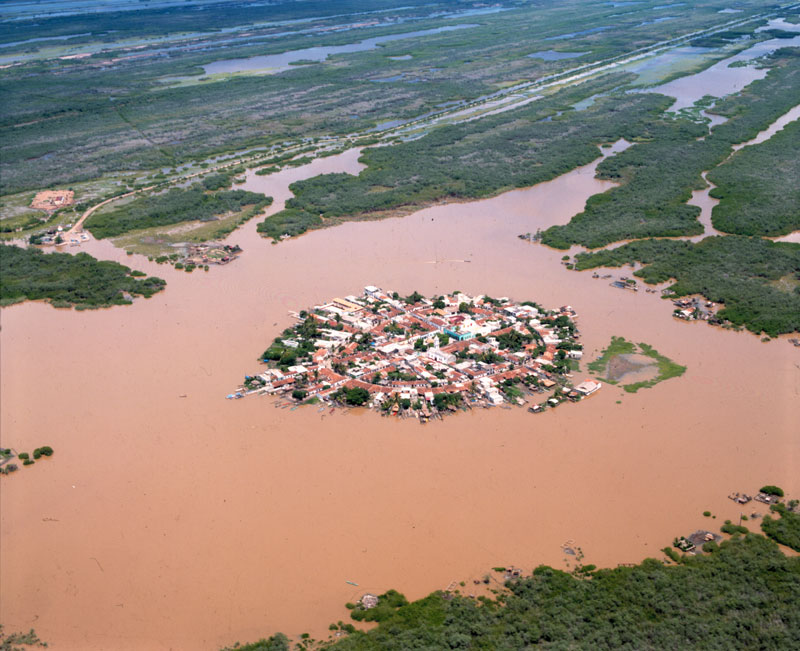
Photo: Comisión Mexicana de Filmaciones · CC BY-SA 2.0

Aztlán — 'place of the herons' or 'place of whiteness' in Nahuatl — is the island homeland from which the Mexica (Aztecs) said their ancestors departed on the generations-long migration that ended with the founding of Tenochtitlan in 1325. The journey is painted across surviving codices, most famously the Codex Boturini, which opens with a figure paddling away from an island in a lake. Where, if anywhere, that island lay has been argued over since the 16th century. The best-loved modern candidate is Mexcaltitán, a tiny oval island town in a Nayarit lagoon whose canal-like flooding streets and heron-filled wetlands give it an uncanny resemblance to the codex images — while other theories reach as far as the US Southwest, where Aztlán took on a second life as the symbolic homeland of the Chicano movement.

See it on the globe →
The mainstream view

What archaeology says

Most Mesoamericanists treat Aztlán as mytho-historical: a tradition that likely preserves a genuine memory of migration from somewhere north-west of the Valley of Mexico, wrapped in layers of political myth-making. The Codex Boturini (the Tira de la Peregrinación), painted on a five-and-a-half-metre strip of amate paper soon after the conquest, shows the departure from an island Aztlán, the intervention of the god Huitzilopochtli at Chicomoztoc (the Seven Caves), and the long wandering of the tribes. Scholars such as Miguel León-Portilla, Alfredo López Austin and, more recently, Camilla Townsend in her history Fifth Sun, read these accounts as origin charters: the island-in-a-lake motif deliberately prefigures and legitimises Tenochtitlan itself, an island city in Lake Texcoco. Tellingly, the Aztecs themselves treated Aztlán as semi-legendary — the chronicler Diego Durán records that Moctezuma I sent an expedition of sorcerers to find it, and they returned with tales of a magical land reached by transformation, not geography.

Linguistics supports a northern origin in general terms without endorsing any specific site: Nahuatl belongs to the Uto-Aztecan family, whose other branches stretch through northern Mexico into the western United States, so Nahuatl speakers certainly arrived in central Mexico from the north, probably in waves during the 12th and 13th centuries after the fall of Tollan. But specialists caution that a homeland of a language family thousands of years deep says little about a specific island departed in AD 1064 or 1168 — the dates the annals give — and no archaeological site has ever been convincingly identified as Aztlán.

Key evidence cited
  • The Codex Boturini and related codices consistently depict Aztlán as a stylised island — a mythic mirror of Tenochtitlan
  • Diego Durán's account of Moctezuma I's magical expedition, showing the Aztecs themselves treated Aztlán as legendary
  • Uto-Aztecan linguistics confirming a general northern origin for Nahuatl speakers, without any specific site
  • Annals dating the departure symbolically (1 Tecpatl years such as 1064 or 1168), typical of calendrical myth-making
  • No archaeological evidence at Mexcaltitán or any other candidate linking it to the Mexica migration
The alternative view

What the skeptics propose

The Mexcaltitán claim is Mexico's favourite answer. The island town — an almost perfectly oval grid of streets that flood in the wet season, when residents historically moved about by canoe, earning it the nickname 'the Venice of Mexico' — sits in a heron-rich lagoon on the Nayarit coast, in exactly the north-western coastal zone several colonial sources imply. Promoted by Nayarit historians and enthusiasts from the mid-20th century, the identification rests on the visual match with codex imagery, the abundance of aztatl (herons), the town's radial 'cosmogram' layout, and regional traditions; it was celebrated during the 1980s and 1990s (the island hosted symbolic events around the Aztec migration anniversary) and gained Pueblo Mágico status in 2020, cementing the origin story in its tourist identity. Archaeologists note, gently, that no pre-Columbian remains found there demonstrate the link — but nothing has disproved it either, and the resemblance remains striking.

North of the border, Aztlán became something larger than a place. Some 19th- and 20th-century writers located it in the US Southwest — candidates have included the Colorado River delta, Utah's lakes and various Ancestral Puebloan regions — partly on Uto-Aztecan linguistic grounds. In 1969 the poet Alurista and the First National Chicano Youth Liberation Conference in Denver, convened by Rodolfo 'Corky' Gonzales, adopted El Plan Espiritual de Aztlán, declaring the lands annexed by the United States in 1848 to be the Chicano homeland — Aztlán reborn as a symbol of identity, indigeneity and reclamation. Scholars such as Rudolfo Anaya and Daniel Cooper Alarcón have traced how the myth keeps regenerating: whether or not Aztlán ever had coordinates, it demonstrably has power, functioning for modern communities much as it did for the Mexica — an origin story that dignifies the present.

Key evidence cited
  • Mexcaltitán's striking visual match with codex depictions: an oval island town in a lagoon, streets flooding into canals
  • Abundant herons and aquatic resources at Mexcaltitán, matching the meaning of the name Aztlán
  • Colonial sources placing Aztlán vaguely to the north-west, compatible with the Nayarit coast
  • The 16th-century search itself — Spanish chroniclers recorded serious Aztec belief in a real homeland
  • US Southwest linguistic arguments placing early Uto-Aztecan speakers in the region claimed as Aztlán by the Chicano movement

Genuinely open questions

  1. Does any archaeological trace of the proto-Mexica migration survive along the proposed routes from the north-west?
  2. Was Aztlán a single real place, a composite memory of several stopping points, or pure charter myth?
  3. Why did the Mexica date their departure to a 1 Tecpatl year — history, or calendrical symbolism?

Worth knowing

Mexcaltitán's streets are laid out like a spoked wheel and flood in the rainy season — for centuries residents simply switched from walking to canoes, which is precisely how the codices show life in island Aztlán.