Lost Worlds · Leading candidate: Iceland

Thule, the Edge of the World

A Greek scientist sailed to the Arctic 2,300 years ago and was called a liar for two millennia — his lost book described the midnight sun and the frozen sea.

Mainstream: Reported by Pytheas of Massalia, c. 325 BC, six days' sail north of BritainAlternative: Location contested — Iceland, Norway, Shetland or Saaremaa; later mythologised as a lost Hyperborean homeland64.96°, -19.02°

At a glance

Thule, the Edge of the World
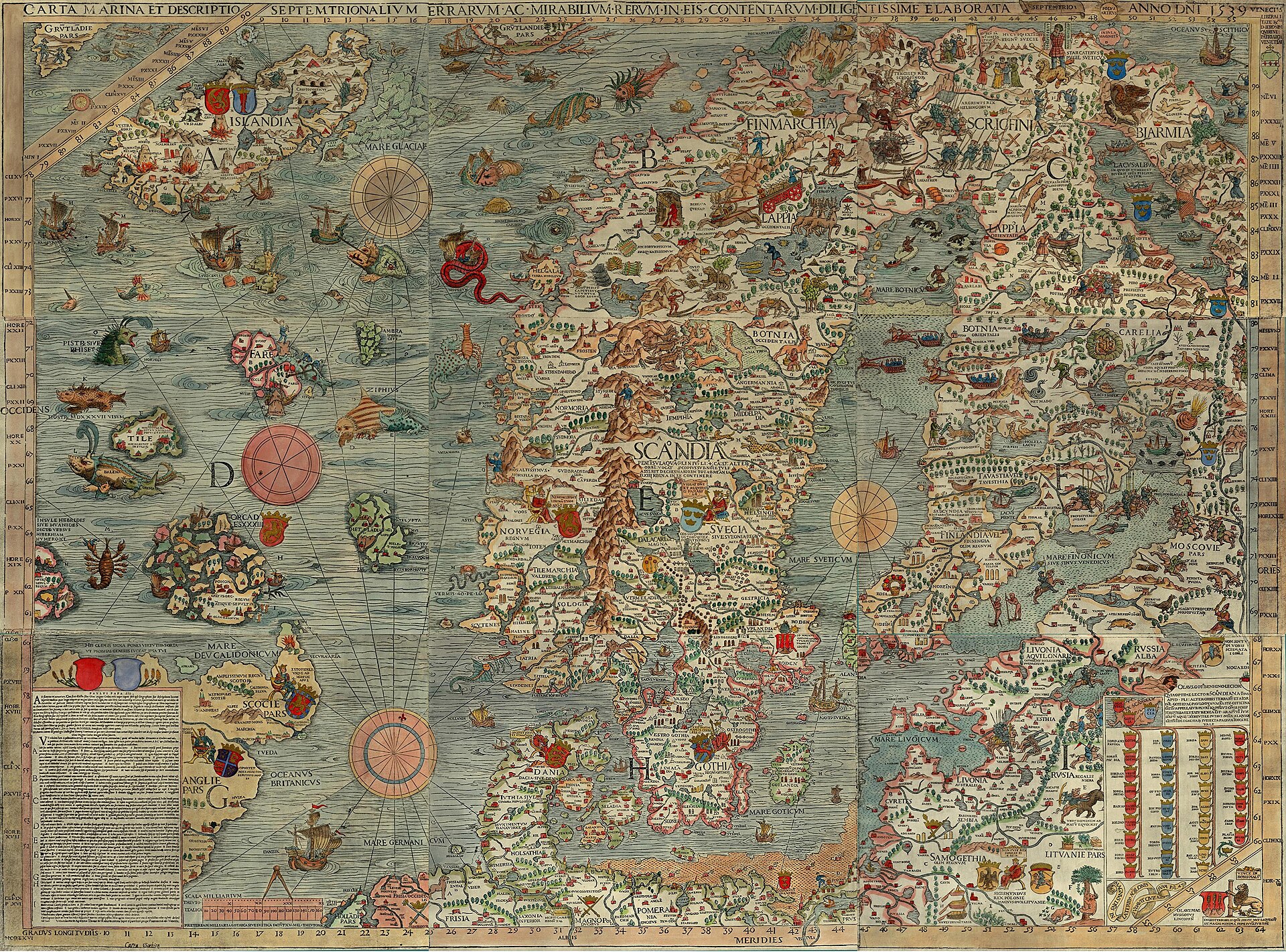
Photo: Olaus Magnus (1539) · Public domain

Around 325 BC, Pytheas, a Greek navigator and astronomer from the colony of Massalia (Marseille), made one of antiquity's greatest voyages: out of the Mediterranean, around Britain — which he was the first to describe and roughly measure — and onward six days' sail to the north, to a land he called Thule. There, he reported, the summer sun barely set, the inhabitants ate grain and honey, and one day's sail further on lay something he called the congealed sea, where sea, air and slush merged into a substance like a 'sea-lung' through which one could neither walk nor sail. His book On the Ocean is lost; we know it only through fragments quoted, often scornfully, by later authors. Thule became the Roman poets' Ultima Thule, the ends of the earth — and, much later, the target of one of history's ugliest acts of name-theft.

See it on the globe →
The mainstream view

What archaeology says

Modern scholarship has largely rehabilitated Pytheas as a careful observer. Sir Barry Cunliffe's The Extraordinary Voyage of Pytheas the Greek (2001) reconstructs the journey from the surviving fragments and argues the details ring true: Pytheas took repeated latitude measurements by gnomon (his figure for Massalia was almost exact), described the midnight sun and the two-to-three-hour northern night with quantitative precision, and reported tidal and sea-ice phenomena a stay-at-home fabricator could not have invented. The 'congealed sea' reads naturally as the pancake- and grease-ice fringe of the drift-ice edge, and the description of a land where cultivation gives way to millet, herbs and honey-based drink fits a real subarctic encounter. Cunliffe, like the polar explorer Fridtjof Nansen's great predecessors in this debate, weighs the candidates — Shetland, the Faroes, Norway's Trondheim coast — and comes down for Iceland, six days' sail north of Britain and one day short of the drift ice, though many scholars still prefer coastal Norway, since Pytheas describes Thule as inhabited and farming, and there is no archaeological evidence of settlement in Iceland before the mid-first millennium AD.

The irony is that antiquity mostly disbelieved him. Polybius, followed at length by Strabo, branded Pytheas the 'arch-falsifier', mocking the sea-lung and doubting a private citizen could have travelled so far; Strabo used Thule chiefly as a stick with which to beat sloppy geography. Yet Eratosthenes and Hipparchus trusted Pytheas' latitudes enough to build them into their world models, Ptolemy fixed Thule near Shetland, and when Irish monks and then Norse settlers actually reached Iceland in the early medieval period, the learned name Thule was waiting for it. The scholarly debate today is not whether Pytheas sailed — that is broadly accepted — but exactly where six days from Britain took him.

Key evidence cited
  • Pytheas' surviving latitude data (via Hipparchus and Strabo) are accurate where checkable, supporting a real voyage
  • His midnight-sun and short-night reports match high-latitude reality unknown to Mediterranean armchair geographers
  • The 'congealed sea' and 'sea-lung' closely describe the grease- and pancake-ice of the drift-ice margin
  • Cunliffe's reconstruction shows six days' sail north of Britain fits Iceland (or northern Norway) in Bronze–Iron Age seafaring terms
  • Eratosthenes, Hipparchus and Ptolemy incorporated Pytheas' data despite Polybius' and Strabo's polemics
The alternative view

What the skeptics propose

The liveliest fringe of the Thule question concerns alternative locations and later mythmaking. In 1976 the Estonian writer (and later president) Lennart Meri proposed that Thule was Saaremaa in the Baltic, linking the name to the Finnic root tule, 'of fire', and to the Kaali meteorite craters — arguing that folk memory of the fiery impact, which some datings place in the Bronze Age, echoes in Estonian folklore of the sun falling to rest on the island. The idea remains popular in Estonia, though archaeologists such as Marika Magi and classicists point out it requires Pytheas to have sailed east into the Baltic against the plain sense of the sources, and recent datings push the Kaali impact centuries before any plausible connection. Others have revived Procopius' quite different 6th-century Thule — a vast northern land beyond the Danes, clearly Scandinavia — to argue the name always meant Norway.

Darker appropriations followed. Nineteenth- and early 20th-century esotericists fused Ultima Thule with Atlantis-style lost-continent speculation, imagining it as the polar homeland of a primordial 'Aryan' race — a fantasy institutionalised in 1918 when the Munich occultist circle around Rudolf von Sebottendorff named itself the Thule Society. The society sponsored the German Workers' Party, which Hitler rebuilt into the Nazi Party, and though its direct influence on later Nazi policy is often exaggerated in popular books, the association permanently stained the name: as late as 2019, NASA renamed the Kuiper Belt object it had nicknamed Ultima Thule to Arrokoth after the connection was raised. None of this, historians stress, has anything to do with Pytheas, whose Thule was a real place observed by a working scientist — the misappropriation is a case study in how legends are hijacked long after the facts are lost.

Key evidence cited
  • Thule is described as inhabited and farming, yet Iceland shows no settlement archaeology before the mid-first millennium AD
  • Procopius' Thule is unambiguously Scandinavia, suggesting the name attached to Norway in some traditions
  • Meri's Saaremaa hypothesis links the name to the Finnic fire-root and the Kaali meteorite craters and their folklore
  • Ptolemy's coordinates place Thule at Shetland's latitude, a candidate defended on sailing-time grounds
  • Esoteric writers cite the Thule myth-complex as memory of a lost northern homeland (a claim without archaeological support)

Genuinely open questions

  1. Which land did Pytheas actually reach — Iceland, Norway, Shetland or somewhere now unidentifiable?
  2. Was Thule's described population real observation, hearsay gathered in Britain, or a later copyist's confusion?
  3. Could any fragment or paraphrase of On the Ocean yet be recovered from unread papyri or palimpsests?

Worth knowing

NASA nicknamed the most distant object ever visited by spacecraft 'Ultima Thule' — then formally renamed it Arrokoth in 2019, after journalists pointed out the name's hijacking by the Thule Society a century earlier.