Catastrophe & Climate · Podkamennaya Tunguska River region, Krasnoyarsk Krai, Siberia, Russia

The Tunguska Event

The day a piece of the sky flattened a Siberian forest, and became the go-to analogue for ancient cosmic catastrophe.

Mainstream: 30 June 1908Alternative: 1908, cited as a small modern echo of a far larger ancient event60.89°, 101.89°

At a glance

The Tunguska Event
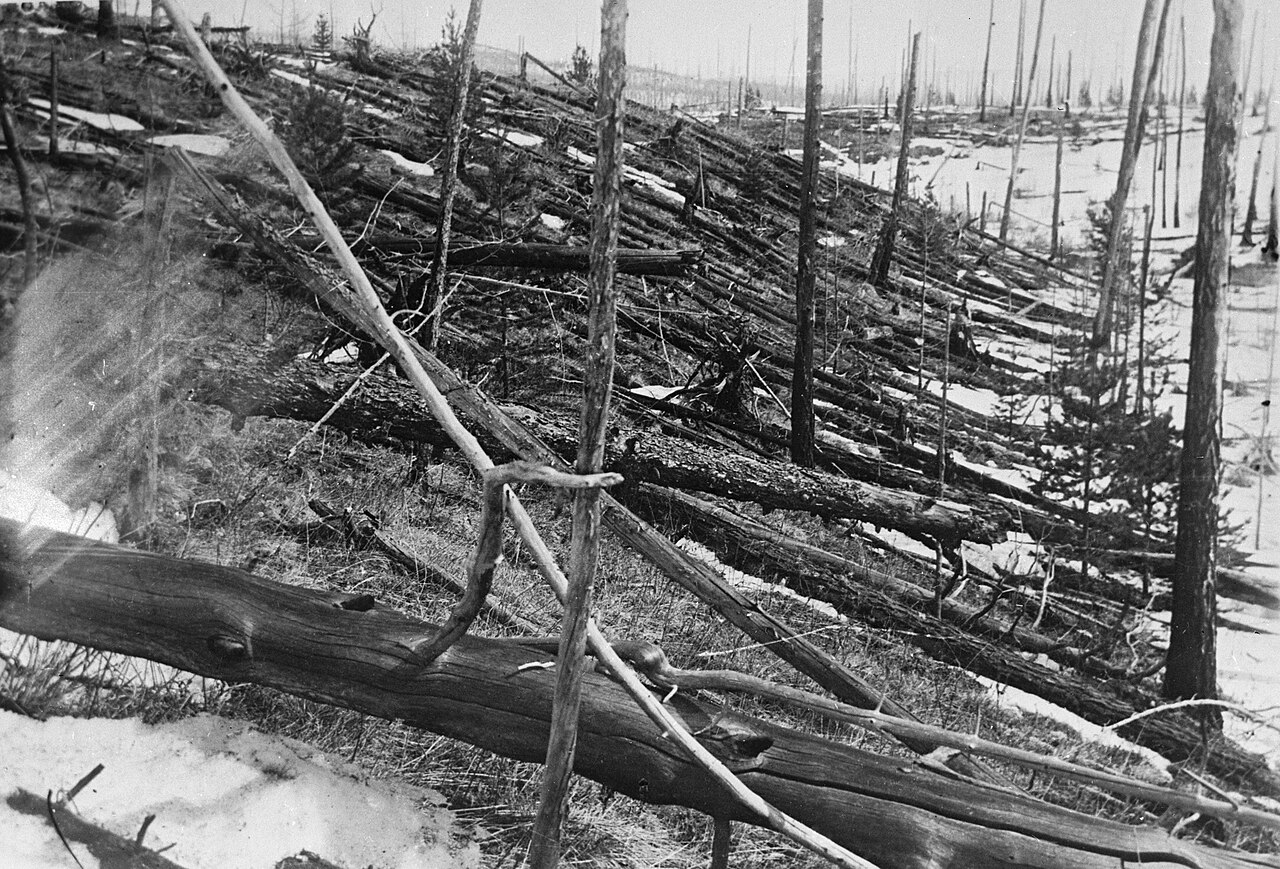
Photo: Leonid Kulik · Public domain

On the morning of 30 June 1908 an object from space exploded a few kilometres above the Siberian taiga near the Podkamennaya Tunguska River. It left no crater, yet it flattened some 2,000 square kilometres of forest and knocked over an estimated 80 million trees. Because it was an airburst rather than a ground impact, Tunguska has become the key modern reference point for arguments about how a comet or asteroid could devastate the surface without leaving an obvious hole, exactly the puzzle at the heart of catastrophist theories.

See it on the globe →
The mainstream view

What archaeology says

The Tunguska event is accepted as the largest airburst in recorded history. A stony (or possibly cometary) body tens of metres across entered the atmosphere and exploded, releasing energy estimated at several to a couple of dozen megatons of TNT. The blast wave felled trees radially over a huge area, yet the object was destroyed in the air, so no primary impact crater formed.

Expeditions from the 1920s onward, beginning with Leonid Kulik, documented the flattened forest and searched, largely in vain, for meteoritic remains, which fits an airburst that vaporised most of the body. Later studies have refined the energy, altitude and likely composition.

Tunguska is scientifically important precisely because it shows that a modest object can cause regional devastation with only subtle geological traces. That makes it a natural yardstick, and it is invoked in serious discussions of impact risk (planetary defence) and, more controversially, in debates over whether larger prehistoric airbursts left similarly ambiguous signatures.

Key evidence cited
  • Roughly 2,000 square kilometres of forest were flattened radially, consistent with a high-altitude airburst.
  • No primary impact crater exists, matching an object destroyed in the air rather than on the ground.
  • Energy estimates of several to about two dozen megatons come from the blast pattern and seismic and barometric records.
  • Early expeditions led by Leonid Kulik mapped the devastation and found little meteoritic material.
  • Atmospheric effects, bright nights across Eurasia, were recorded far from the blast site.
  • The event is a standard case study in planetary defence and impact-risk assessment.
The alternative view

What the skeptics propose

For catastrophist and alternative writers, Tunguska is the proof of concept. If a stony body a few tens of metres wide can flatten a forest the size of a city and leave essentially no crater, then, they argue, far larger prehistoric airbursts could have devastated whole regions while leaving only diffuse traces, soot, spherules, scorched layers, rather than obvious craters. This is the crux of the Younger Dryas Impact Hypothesis of Richard Firestone, Allen West and James Kennett, and of the Taurid-stream ideas of Victor Clube and Bill Napier, who proposed that Earth periodically crosses debris from a giant fragmenting comet, with Tunguska a small sample of the hazard.

Graham Hancock and others lean on Tunguska to answer the obvious objection to ancient impact theories, where is the crater? The answer offered is: an airburst need not leave one.

The honest standing is mixed. Tunguska itself is solid, undisputed science. What remains contested is the extrapolation, that similar or larger airbursts triggered the Younger Dryas or destroyed ancient cultures. That larger claim is where mainstream scientists part company, even as they accept Tunguska as real and instructive.

Key evidence cited
  • It proves a small cosmic body can devastate a region without leaving a crater, answering a key objection to ancient airburst theories.
  • It is cited as a modern miniature of the Younger Dryas impact proposed by Firestone, West and Kennett.
  • Clube and Napier link it to the Taurid meteor stream, framing Earth as periodically exposed to cometary debris.
  • Its craterless, trace-poor signature is used to argue larger ancient airbursts could hide in the record.
  • Recorded within living memory, it removes any doubt that such events actually happen.
  • Some researchers report high-temperature impact-type materials at the site, cited to bolster airburst analogues.

Genuinely open questions

  1. Was the Tunguska body an asteroid or a cometary fragment?
  2. How reliably can far larger, far older airbursts be recognised if they leave no crater?
  3. Is the Taurid stream a genuine recurring hazard on the scale catastrophists propose?
  4. Does Tunguska really support the Younger Dryas impact case, or only show that airbursts happen?

Worth knowing

The first scientific expedition did not reach the blast site until 1927, nineteen years later, and still found trees standing upright but stripped bare at ground zero, directly beneath where the object exploded.